
Don’t dump that old Minolta 4000 AF Flash. It won’t fit the hotshoe on your Sony Alpha dSLR, but you can still put it to work.
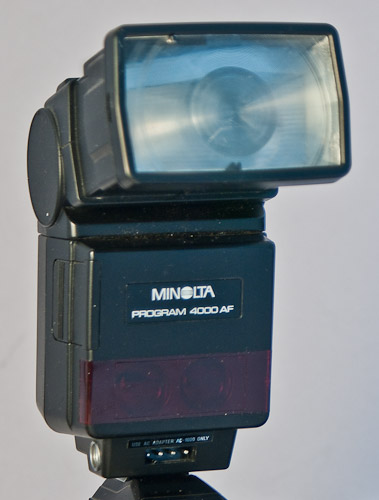
The Minolta 4000AF Flash Unit. Big, powerful, plentiful and relatively inexpensive. Too bad it cannot be used with the Sony Alpha. At least, that is what many of the authority sites tell you. Even some web sites I respect and recommend indicate the big flash doesn’t work with the Sony Alpha.
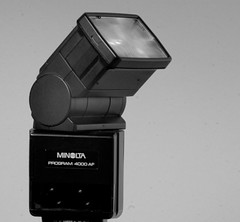
Fortunately for Sony Alpha shooters who are in the market for an inexpensive flash, that is a whole lot of hogwash. I have taken thousands of photos using this combination, and I’m here to tell you the Minolta 4000AF works beautifully with the Sony Alpha.
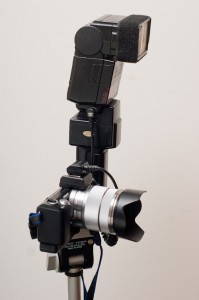
Please read this entire series carefully. The Minolta 4000AF does not fit the hotshoe on the Sony Alpha and will require you to set the power manually. With a little creativity, however, you find the big flash produces excellent auxiliary lighting.
You don’t need a dedicated flash unit
Minolta 4000AF Flash
at a Glance
Introduced: 1985
Weight: 1lb 5oz (with batteries)
Guide Number: 131ft / 40mtr (at 50mm zoom position)
Power: 4 AA Cells | Powergrip | AC Input
The Good
- Powerful
- Manual Power Settings
- Power Zoom Head
- Good Battery Life
- Sony Flash Connector
- Bounce and Swivel capabilities
The Bad
- Bulky and heavy
- No TTL Flash with Sony Alpha
- Older International Hot Shoe Foot
- Sony/Minolta Wireless Flash Not Supported
- Separate Wide Angle Defuser Panel
- Power Setting Difficult to Read
First off, let me define what I mean when I say this flash works. If your idea of working includes a fully automatic TTL (through-the-lens metering) experience, with exposure controlled by the camera, then the 4000AF does not work with the Alpha. On the other hand, if your definition of working means a flash unit that will sync with the camera and features manually adjustable power settings, then the 4000AF can be everything you want.
Before you get too hung up on the lack of through-the-lens capabilities, you need to realize that many of the top advertising photos you see are photographed with studio strobe lights. Few, if any studio photographers attempt to use TTL control. Instead the photographer is responsible for setting the power and location the lights. If expert photographers can create award-winning magazine covers and advertising spreads without resorting to dedicated TTL metering, what’s stopping you and me? When you realize that you can pickup good 4000AF flash units for well under $50, the idea of needing a TTL Flash becomes even less compelling.
I can hear the complaints already. “…manually setting my flash is hard. And I don’t own a flash meter…”
In actuality it is fairly simple to set up an adjustable power flash like the 4000AF. And while you might not realize it, that LCD on the back of your Sony Alpha can serve as a pretty accurate flash meter.
The Minolta 4000AF Flash: A Closer Look
Let’s take a closer look at the 4000AF. When Minolta introduced the all new Maxxum cameras in 1985, they also introduced several new accessories, including a powerful new flash unit. I assume the AF tag indicates this flash was designed for the new for 1985 Minolta Auto Focus SLRs. The 4000AF remained Minolta’s flagship flash unit for years, which means you can find good, usable copies on eBay, Craig’s List, garage sales and used camera outlets. There are even suppliers who sell used Minolta 4000 AF flash units on the Amazon Marketplace.
The 4000AF and Trigger Voltage
One major consideration when attempting to match old film flash units with modern dSLRs is trigger voltage. In older, mechanical cameras, there were no electronics or integrated circuits, so flash designers were free to utilize very high trigger voltages. Some older flash units have trigger voltages that exceed 600 volts! I would not want to use one of these units anywhere near an electronic camera.
Newer flash units usually utilize much lower trigger voltages in order to avoid damage to the electronic circuitry in modern cameras.
As far as I know, Sony has not published the recommended maximum trigger voltage for the Alpha line, but many camera technicians recommend keeping electronic flash trigger voltages under 6 volts for digital cameras.
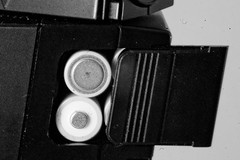
Originally, I worried that the huge 4000AF flash might have a high trigger voltage. I was pleasantly surprised to read on the Botzilla Trigger Voltage Comparison site that the 4000AF only has a Trigger Voltage of 1.85-2.5 volts – among the lowest I have seen. I have never tried to measure the voltage of any of my 4000AF units, but having used multiple 4000AFs on the Sony Alpha for several years without a problem, I trust that the Botzilla site is accurate. Of course your mileage could vary, so you are advised to check your flash according to the instructions on the Botzilla site. I believe the 4000AF is safe to use with the Alpha, but determining if a flash unit is safe for your camera is your responsibility.
Minolta 4000AF Features
Although it is big and heavy, the 4000AF has most of the features you might expect from a top of the line flash.
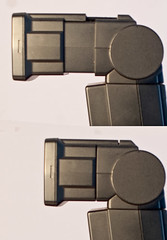
The head tilts from zero to ninety degrees, and can swivel 90 degrees to the right or left. Many newer flashes can swivel as much as 180 degrees, allowing the photographer to point the head backwards. You cannot rotate the head backwards on the 4000AF, but the way I use the 4000AF this really doesn’t matter.
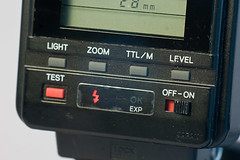
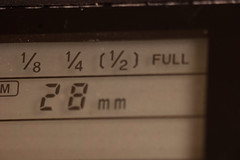
The flash has a power zoom head which can beam the light according to the lens being used. The zoom head adjusts from 28-70mm. If you use a telephoto lens, the ability to zoom the flash head is great feature. Used with an A-mount lens on the Sony Alpha, the 4000AF will automatically zoom the flash head according to the focal length of the lens. The zoom can be manually controlled as well, allowing you to adjust the flash zoom range for the conditions.
To cover a wide-angle lens, the photographer needs to snap a plastic defuser over the flash head. This is less convenient than with most modern flash units, which generally incorporate the defuser with an onboard, flip-up arrangement. Since the defuser is a separate piece on the 4000AF, the defuser panel is easy to misplace. In addition, there is a good chance you might not have it with you when you need it.
With a guide number of 131 feet (45 meters), the 4000AF is quite powerful. The flash does not boast High Speed Sync or ADI capability, but that power and inexpensive price tag helps make up for any lack of features.
Sadly, the 4000AF came out before Minolta developed their wireless flash system, so it is not compatible with the Sony wireless optical flash trigger.
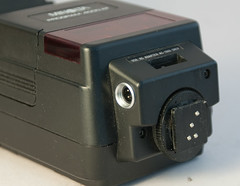
When you study the 4000AF, one of the first things you’ll notice is that the foot is not compatible with the Minolta/Sony hot shoe. The early Maxxum cameras used the standard slip on hot shoe design, so obviously the 4000AF is designed with a slip on foot.
Who Cares About the Hot Shoe?
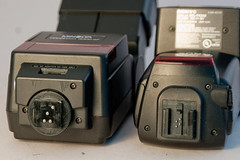
The Alpha hot shoe uses the newer Minolta design, which means you cannot use the 4000AF in the hot shoe of a Sony Alpha. Is that a problem? Only if you insist on using your flash in the hot shoe, when every serious photographer on the face of the planet recommends off-camera flash. Firing your flash from the hot shoe gives you flat light, increases red-eye and generally results in boring photographs. Don’t believe me? Search the web for off-camera-flash and see how many famous photographers advise against shooting with a flash in the hot shoe.
If you are not going to shoot from the hot shoe, it really doesn’t matter whether your flash is compatible with your flash shoe or not. What does matter is that you have a way to sync (fire) the flash at the proper time.
So how do we do that? That will be the subject of my next post.
This is the first post in a multi-part series which explains how to use the Minolta 4000AF Flash Unit on the Sony Alpha.
- The Minolta 4000AF Flash and the Sony Alpha
- Using the Sony FA-CC1AM for Off-Camera Flash
- Syncing the Minolta 4000AF from the Sony Alpha
- Gallery of images taken with the 4000AF and Sony Alpha
Minolta 4000AF on Amazon Marketplace
Current Minolta 4000AF Auctions on ebay

Instead of mucking about with external sync terminals, I just bought a Vivitar Digital-ready alpha-mount flash on Ebay for about $99 direct from Hong Kong. Works just as well as a sony-brand $500 flashbulb, and it’s $400 less.
Warren
I’m waiting for “Using the Sony FA-CC1AM for Off-Camera Flash” !!
😀
Just got one for 35€!
Great, well written, informative article. Sounds great! When is the next part coming?
I have 3 of those ( my Strobist Kit) complete with:
-AC-1000 AC Adapter that lets you use AC power with fast recycle times (only weird thing is you still need batteries in the flash to zoom)
-PS-1000 Panel Set that include 85B(Orange), Red, Yellow, 80B (Blue) and Green filters so a lot of creative background or other illumination is possible
– Bounce Reflector II: Folding umbrella type reflector that includes a clear holder that i use with colored gels without the need for Velcro
– Control Grip CG-1000 that has a 6AA battery pack for faster recycling and a PC socket to trigger regular flashes.
Cable OC-1100 from Minolta (sony equivalent FA-CC1AM) can connect direct on the flash side and if used along with Minolta Off Camera shoe allow regular connection to you Alpha body and mounting on a tripod. Regular PC socket shoes can also be used with PC Cords and having a D-Lite it Elinchrom kit, i can trigger these through the optional Elinchrom Skyport Speed Receiver therefore giving me additional possibilities even along my studio kit.
I realize these items are now pretty difficult to find but i purchased in the last 12 months a complete 2 flash kit with AC/Panels/Bounce Reflector all separately for less than 200 $ ( a used HVL-F42 costs about the same but no AC option , no coloured panels and no reflector). I already had the first kit from the era of the Maxxum 9000.
Since i got this, i just stopped adding to my studio kit since these are usable on batteries or in the studio and they really increase my versatility and since they are all the same, there is no fiddling around to figure how each works.
Is the power connector for the Metz 7325 flash the same as that of the Minolta AF 4000?
Need to connect a Minolta flash to a Godox Propac PB820 power pack. Power cable for that model flash hard to come by. Connector (from photos) looks quite similar to that of the Metz
I love the idea of re-use of electronics in general and really appreciate this idea for it. I’ve heard people say that “lenses are forever” as a justification for buying them – it would be nice to be able to same the same for flashes and I guess it can be to a certain degree.
Or you just buy a hot shoe adaptor for the Sony and everything works TTL. I bought one for my daughters A330 off ebay and no problems reported.
I have recently purchased a Sony Cyber-Shot DSC HX300 which unfortunately is not equipped with a hot shoe nor does it have a PC connection. I would like to use my Minolta 4000 AF flash unit on the new Sony.
I have already tried both units marketed by an Indian company called Nisha; the Digital Programmable Slave Unit model number FSU-DIG and the FSU-R. Neither would fire the 4000 AF even though the programming function of the slave worked perfectly. My guess is that the problem lies with the proprietary pin-out of the 4000 AF.
Can someone recommend a solution to my problem, hopefully one device that will work with the 4000 AF?
Thanks a bunch!
Bob
Hi Bob, Thanks for your question. I have no experience with the DSC HX300, so I cannot be much help. Maybe another reader can offer a suggestion.
One thing I do know about the 4000 AF on my Sony dSLRs, is that both the trigger flash and the remote flash need to be in the manual mode to be triggered with a remote slave. If I try to trigger the 4000 AF with a slave unit using the built in pop-up flash, it fires too early because the pop-up flash does not have manual control. Because the pop-up is a TTL flash, the remote flash will be triggered by the pre-flash circuit. This causes the remote flash to fire before the shutter opens. In this case it has no effect on the image exposure. You will still see the flash fire, however, it just doesn’t sync with the shutter.
Since you say your flash does not fire, this probably doesn’t apply to you. Still, I would look through your owners manual to see if there is any provision to fire the built-in flash with a manual setting. If so, set your built in flash and the 4000 AF to manual and try the slave again. Probably won’t help, but it is worth a shot.
Anyone else have any advise for Bob?
Tom,
Thank you so much for your response. Given the age of the thread I was in doubt of getting one.
I have researched the manual, (I still have the original one from when I bought the Minolta 7000i camera and the 4000 AF flash new back in ’87!), and have found nothing.
In trying the slave unit, I found that the third line of the LCD display on the flash unit in which the TTL info in displayed was always blank. Pressing the “TTL/M” button the flash head had no affect.
I even had he importer of the Nisha units try it on a 4000 AF that he had, all to no avail. He also said that he would notify the manufacturer of the issue as their literature claims that the device will fire any flash whether analog or digital.
Anyway, hopefully someone else will have a positive answer for me.
Thanks again, Tom.
Bob