Archive for the 'Lenses' Category

Sony Alpha news explodes at PMA 2008

Sunday, February 3rd, 2008

What a difference a year makes. At the 2007 PMA show Sony Alpha dSLR line was shunned by most of the press. There were no great announcements, although Sony did show off two mockups of yet unnamed dSLRs. The “Advanced Amateur” model eventually came to pass as the A700, while the tantalizing “flagship” is still waiting to be released. Other than the concept cameras, which Sony refused to elaborate on, there wasn’t much to see. The press lavished tons of coverage to other major and minor dSLR offerings, but except for the few A-mount sites and forums, Sony was just a postscript at PMA 2007.

Sony was not about to let that happen again. The 2008 PMA show was packed with Sony and Sony Alpha dLSR news. Of course everyone is still talking about the incredible 24mp, full-frame sensor that Sony announced, and the introduction of not one but two new live view dSLR bodies caught a lot of people by surprise. The A300 and A350 are a huge shot in the arm to the Alpha line, and should go a long way to convince potential customers that Sony is serious about playing in the dSLR arena.

In the excitement of the huge sensor and live-view SLR announcements, many observers may have overlooked Sony’s release of several new dSLR accessories.

New Sony HVL-F42AM Flash

Sony will add a new flash unit to their existing Alpha flashes.

The first totally new Sony Alpha Flash unit, the HVL-F42AM, will be available in the near future. The other Flashes in Sony’s line up appear to be re-badged versions of Minolta flash units. That isn’t a bad thing, Minolta’s wireless flash system was considered by many to be excellent.

The new HVL-F42AM might appear to be a middle of the road unit, filling the gap between the the HVL-F36AM (GN 36) and the big HVL-F56AM (GN 56). While the new flash’s guide number of 42 does place between the current two Sony shoe mount flash units, the HVL-F42AM has an zoom range of 24-105mm. You can cover up to a 16mm lens with wide angle adapter. The current flashes in the Sony catalog offer a range of 24-85mm and the adapter covers 17mm.

As usual, Mike Hohner seems to have an inside track on Sony’s latest products. Here is Hohner’s “Flash tech data for Sony Alpha HVL-F42AM” page.

There is also a Sony Europe press release covering the PMA announcement floating about. Here’s what the release has to say:

Available as an option, the powerful new HVL-F42AM Flash unit is ideally suited to the needs of experienced digital photographers and newcomers alike. Alongside ADI metering and wireless remote operation, it offers automatic WB adjustment with colour temperature information plus an evolved Bounce System with vertical adjustment up to 90 degrees, left to 90 degrees and right to 180 degrees.

With wireless, ADI and manual modes, plus a full range of tilt and swivel possibilities, the new flash unit sounds like it might be an excellent addition to any A-mount user’s camera bag.

Then there are the lenses. Although technically not a PMA announced product, Sony’s latest two lenses were introduced on the eve of the show, so they might as well be considered new PM products. Both of the new lenses use SSM technology for quicker auto focusing.

Carl Zeiss® 24-70mm f/2.8 lens

Say hello to the Carl Zeiss® 24-70mm f/2.8 lens

Coming this spring, the $1,700 Vario Sonnar T* 24-70mm f/2.8 ZA is a very-fast, wide to mid range zoom lens. According to the Sony release:

Co-developed with Carl Zeiss®, the SAL2470Z model is a wide angle 24-70mm zoom lens with a large f/2.8 aperture, ideally suited for discerning landscape and portrait photography. Constructed of 17 elements in 13 groups with two aspheric elements and two extra-low dispersion elements, this lens exhibits excellent contrast and center-to-edge resolution. Its exclusive Carl Zeiss T* (T star) coating technology provides higher light transmission, and minimizes flare to produce images of luminous clarity, color and sharpness.

The SAL2470Z lens excels in difficult lighting circumstances thanks to its f/2.8 aperture, which remains constant throughout the focal length range. The nine-blade, circular iris is especially useful in controlling background defocusing in portrait and landscape images. Combined with Sony’s in-camera Super SteadyShot® system, this lens is the only full-frame compatible large aperture standard zoom with the benefit of image stabilization available in the industry.

Quick and precise focusing is delivered by Sony’s Super Sonic wave Motor (SSM) technology. This SSM system utilizes a solid-state focus drive motor that features silent, high-speed response with high-torque and fine rotational control – especially important for large, wide aperture lenses. A mode selector for manual and automatic focus as well as a focus hold control is provided on the lens barrel.

The second new lens, also available this spring, is the $800 70-300mm f/4.5-5.6 G-series zoom.

The SAL70300G lens incorporates the optical performance of Sony’s G series in a compact and flexible telephoto zoom lens ideal for sports and portrait photography. Constructed of 16 elements in 11 groups, with one extra-low dispersion element, this lens offers superb contrast and sharpness across its wide focal length range.

The use of extra-low dispersion glass compensates for chromatic aberrations which challenge long telephoto zoom lens design, maintaining excellent optical characteristics from center to periphery. Internal focus construction not only realizes compact size, but also a close focusing capability of just 47 inches (1.2m), unusual for a lens of this focal length range.

Sony SAL70300G Lens

New 70-300 G-series SSM Alpha mount lens

Like the SAL2470Z, focus drive is provided by Sony’s Super Sonic wave Motor (SSM) technology. Silent and highly accurate, the SSM system is ideal for providing larger lenses with the speed and rotational precision often required by telephoto shooting. To match auto focus operation to the situation, a focus range limiter can be set to a minimum distance of three meters. A lens barrel mounted focus hold button locks focus if desired.

These lenses are good ammunition to use against those who imply that Sony doesn’t offer sufficient quality glass to complete against the “established camera makers.” We will have to wait to see how these lenses perform in the real world, but it sounds like they could hold their own against anything similar from other manufacturers.

Next up, the new vertical grip. Again this isn’t technically a PMA product, as it was announced along with the A200. The grip is available now at a lest price of $249.00 (less batteries). The PM news is that it is compatible with the A300 and the A350, as well as the original A200. This provides a great deal of flexibility if you trade up or add second body in the A200-A350 family. It does not fit the A700, which has it’s own specific vertical grip, and will not fit the A100 style bodies.

Also optional, the VG-B30AM Vertical Grip allows comfortable handling in portrait or landscape shooting positions. The grip holds up to two NP FM500H Rechargeable Battery Packs for an extended shooting stamina of up to 1460* images (820 images in Live View mode) from a single charge.
*CIPA standard

With the PMA announcements, Sony has taken a major step forward in it’s quest to become a major player in the dSLR realm. Many observers have relegated the Sony Alpha as niche product, offering some nice features but unable to compete against the big name dSLR makers. Sony continues to add luster to its brand, unhurriedly creating a dSLR system that can compete against the best of the best. As these products begin to gain momentum in the marketplace, watch for Sony to assume a dominate role as a dSLR maker.

Read the complete Sony Alpha Europe Press release

Technorati Tags:
, , , ,

Hi! If you're new here, you may want to subscribe to my RSS feed. You can also sign up to receive e-Mail updates from the homepage at http://alphatracks.com Thanks for visiting!

Sony full frame sensor with anti-shake discussion continues

Wednesday, October 31st, 2007

This will be the final post on the Sony Alpha full-frame sensor / anti-shake quandary. The first in the series outlined the full frame with anti-shake problem, while the second consisted principally of remarks by Bert Pasquale, a well-respected optical engineer.

Since several readers are sill somewhat confused, I have created some illustrations to help explain the situation.

Figure one shows the relative sizes of various sensors, They are drawn to the exact size, but since monitors and screen resolutions vary, the sizes may not be correct on your screen. The size of each sensor in relation to each other, however, is accurate.

size comparison digital sensor

Figure 1: Sensor sizes compared

The red rectangle represents a “full-frame” 24×36mm sensor. The green rectangle is a 17×2mm APSC sensor. The blue rectangle is 90% of a full frame.

Figure 2 shows the APS-C sensor overlaid on a circle that represents the minimum coverage of a 35mm full-frame lens. As you can see, there is plenty of “wasted coverage” as only the area inside the green rectangle will be captured. It is obvious that the sensor can move freely in any direction and still be covered by the lens.

size comparison digital sensor

Figure 2: Coverage of a APS-C sensor by a full-frame lens

Figure 3 is a full frame sensor contained inside the exact same coverage circle. There is no established size for the coverage area, as lenses will vary slightly. The designers only have to create a lens that will offer adequate coverage and sharpness of the 24×36mm film area, and still fit within the lens mount. Of course, the greater the lens coverage, the larger and heavier it will need to be. It will probably be more costly as well, so typically lens designers try to keep near the minimum dimension.

As Mr. Pasquale mentioned, the circle of coverage doesn’t immediately fall off to nothing. Rather, the edge of the circle gradually starts to provide lens light and become less sharp.The fall-off increases slowly until the image eventually fades away.

As you can see from Figure 3, there is little room for the sensor to move without clipping at least one of the corners. Again this will vary from lens to lens, as well as with different focal lengths of a zoom lens.

size comparison digital sensor

Figure 3: Coverage of a full-frame sensor by a full-frame lens

Figure 4 is an arbitrary 90% sensor. You can see that such a sensor is much larger than the APS-C size, yet still has room to float inside the coverage area. I chose this because several people “in the know” have suggested they believe this will be Sony’s answer to the problem. However, some other authorities have suggested that Sony may opt for a 1.25 crop sensor.

size comparison digital sensor

Figure 4: Coverage of a 1.1 crop sensor by a full-frame lens

On the other hand, Mr. Pasquale has suggested that the sensor may not actually move sufficiently enough to require a “crop” lens of any sort. That would be ideal, but until Sony announces the sensor, we really won’t know.

The final figure is one suggested by Alphatracks readers Warren Massey and LEdgars. In their comments, they suggest Sony could simply build an oversize sensor. As you can see by the rectangular outline in figure 5, such a sensor can move some distance in any direction without clipping. The idea is that the big sensor can move around and the camera can crop to a 24X36mm dimension at exposure. it’s a novel idea — but I not sure we will see it in the near future.

size comparison digital sensor

Figure 5: Coverage of a oversize sensor by a full-frame lens

First off, it would be expensive. As sensors increase in physical size, the manufacturing yield is less because typically there are more rejects. Even more significant however, is that an oversize sensor would most likely be confined to the Sony flagship. A full-frame sensor would be attractive to many other dSLR makers and in the past, Sony’s sensor division has profited by selling sensors to a wide range of camera makers. Would Nikon have any interest in an oversize sensor? It’s rather doubtful. Nikon uses a lens based image stabilization method, so there wouldn’t be a need for an oversize sensor.

So if Sony does produce an oversize sensor, their principal customer would be Sony — and for the time being only for the top-of-the -line, limited-production flagship. Would that justify designing and manufacturing an oversize sensor? Or would Sony prefer to invest their resources in a sensor they could sell by the truckload to other camera makers as well as their own dSLR division?

Time will tell, but I’m guessing Sony has a plan up their sleeves. It should be quite interesting!


Free Minolta camera manuals: KM still has ’em online

Friday, August 10th, 2007

Hey! Need a user manual for your SRT101? Or maybe for an old XG-M? Your father in-law gave you his old Maxxum 800si, but you’re unsure how to use it? Look no further than the original source.

I get lots of questions from users asking about manuals. “Where can I get a manual for my Minolta (insert camera model here) ? Since almost any Minolta you acquire will be pre-owned, there is a good chance it will be missing that all important manual.

Many people don’t realize that Konica-Minolta still maintains an excellent collection of original user manuals at the KM support site. Even though KM has exited the camera manufacturing business, they haven’t taken their manuals and software offline. Thus, as this is written (August 2007), you can still find downloadable manuals for almost all of KM’s digital cameras, as well as the majority of AF models. If you are lucky, you will even find a manual for your forty year old manual-focus SLR at the site.

The downloads are free, so if you need a manual for any Minolta camera, scanner, printer, etc. this is the first place to look.

Of course there is always the chance this resource might disappear at some point, and not every Minolta model is represented. If you can’t locate what you need at the KM site, the following sites offer various collections of user manuals.

http://www.vikenk.com/minolta_manual.htm

A fairly comprehensive collection of user manuals covering the Maxxum A-mount and the earlier Minolta manual cameras. There are also some accessory manuals. Most of the manuals are available for free download, although to conserve bandwidth the site requires you to request some of the more obscure items. Viken also sells some Minolta service manuals

http://www.geocities.com/eskoufos/fmm.html

Another great Minolta manual collection. I have used this site in the past and found everything I was looking for. The site offers auto and manual SLR users guides, as well as rangefinders, individual lens manuals, even some free service manuals.,

http://www.kyphoto.com/classics/repairmanuals.html

Site offers free service materials, including four pages of SRT101 disassembly drawings.

http://www.rokkorfiles.com/Manuals.htm

In addition to tons of information about the Minolta manual focus cameras, the Rokkor Files also offers a large selection of scanned Minolta instructions and guides. You can download the PDFs for free, but Andy also has a number of original paper factory manuals for sale.

http://www.ephotozine.com/equipment/manuals/Minolta/64

Lots of scanned manuals covering scanners, flash guns, lenses and of course, cameras.

http://www.photobooksonline.com/books/userbk12.html

The manuals on this site aren’t free, but you’ll find lots of stuff that you won’t see anywhere else. Instead of online PDFs, this site offers reprints of the original paper manuals. They have a large collection, some of it predating the Minolta SLRs, including Autocords and folding Minoltas.

http://www.camerabooks.com/category.aspx?categoryID=1187

Another site selling original instruction manuals. Obviously, the available manuals will vary.

http://www.micro-tools.com/pdf/Minolta/index.html

Great site for free parts manuals. It covers mostly the Konica-Minolta digital stuff, although I did see the Maxxum 5, 7 and 9 film SLRs listed. Sorry, the Maxxum 5D and 7D don’t appear to be available here.

http://www.retrevo.com/samples/Konica-Minolta-manuals.html

This site focuses on electronics, and as such offers lots of printer and scanner manuals. You will find most of the Dimage series camera manuals as well.

Maxxum Dynax AF Lens Repair Manual CD

Pete Ganzel is the original Minolta hacker — he is responsible for a number of incredible Minolta upgrades and mods. Ganzel sells a CD entitled the Minolta Maxxum Dynax AF Lens Service Repair Manual Mini CD, which covers most of the popular Minolta a-mount lenses. The $24.00 CD features 693 pages of information along with hi-res exploded parts diagrams. A must it you are into repairing or modding you Minolta AF lenses.

http://www.tradebit.com/filedetail.php/830435

A site selling a download of a 190 page service manual for the X-700. I haven’t seen it, but if i had a sick X700, I would consider it.

This is only a sampling, but I hope it helps those looking for information on their old, out-of-production cameras. If you know of any other manual sites that shoul be listed here, leave a comment so I can add it to the list.

Rokkor lenses: bedrock of the Minolta SLR legacy

Tuesday, July 24th, 2007

Part 1 of the Alphatracks Minolta/Sony SLR lens guide

Second only to questions about vertical grips for the Sony Alpha A100, the most numerous Alphatracks searches involve lenses. Questions like “Can I use old Minolta lenses on Sony A100?” are frequent. Intriguingly, I have even gotten questions like “Will my new Sony lenses fit on my dad’s old X700?”

Confusion reigns when photographers, especially those new to the dSLR scene, attempt to sort out which Minolta lenses fit which camera. Minolta produced SLR lenses from the 1950s until 2006 — and Sony is still selling re-branded versions of some of the more popular Minolta glass. That is a heck of a lot of lenses. Those new to the world of SLRs hear that the A100 will accept Minolta lenses, so they can be forgiven if they expect an old MC lens from 1972 to attach to the A100. Conversely, there are brand new A100 owners who are doubtful that recent A-mount Minolta lenses will work on their camera.

This will be a three part series focusing on lens options for Minolta SLRs, as well as the KM and Sony dSLRs. I’m not going to explore any particular lens — instead I will delve into the different lens mounts and attempt to dispel some of the confusion.

First up, the Rokkor SR, MC and MD lenses.

Rokkor-X Lens

Minolta — or at least the company we know as Minolta — had a long history producing cameras long before the era of SLRs. After making a variety of rangefinders and the famous Autocord Minolta the the plunge and entered the SLR ranks. The first Minolta SLR, oddly enough, was known as the the SR2, even though it was released before the SR1 model.

Both these SLRs introduced the Minolta designed, three blade bayonet mount. Introduced in 1958, the Minolta mount was superior to most competing contemporary SLR lens mounts. At the time, many competitors still relied on the old-style screw mount. Most SLR makers ended up redesigning their lens mounts to keep up with technology — but the Minolta mount was so well designed that the camera maker was able to consistently update their technology while still keeping backwards and forwards compatibility between cameras and lenses.

The original SR mount lenses were “stop-down” lenses, meaning you had to manually close down the lens to the aperture you wanted. In theory you would focus wide-open, then stop the lens down to make an exposure.

By the time the Minolta SR7 arrived is 1962, Minolta and others had figured out ways to allow the camera to automatically stop the lens down to the correct f-stop. In Minolta’s case, you could focus wide open, then when you pressed the shutter, a rod would cause the lens to close down to the f-stop you had set. As soon as the exposure was finished, the lens would open up again to provide a bright view finder.

The first “MC” lens appeared with the original SRT101 in 1966. This was the first SLR to offer through-the-lens metering. Minolta added a tab to the lens to allow the camera to tell which f-stop the photographer had set. Minolta dubbed these lenses MC for “meter-coupled.” It utilized the same SR lens-mount — but the MC lenses had the extra tab.

Rokkor-X Lens Many MC lenses featured a depth of field preview button. It was redunant, because nearly every Mnolta SLR of the era featued a DOF preview. The DOF lever disappeared from the MD lenses.

It is important to understand that, despite the rapid change and improvements, virtually all Minolta lenses would fit on any Minolta SLR. Of course you needed a MC lens if you wanted to meter with an SRT, but you could use the older SR lenses in manual mode on the SRT. At the same time, you could use a MC lens on a SR series camera with no side effects. There wee a couple of very specialized lenses that might need slight modifications to work properly, but virtually all SR and MC lenses were fully interchangeable.

This happy state of affairs continued as Minolta introduced the improved SRT102. I don’t have any accurate production figures, but in the mid-seventies, Minolta claimed their main lens factory was cranking out 40,000 lenses a month. Add in specialty lenses produced elsewhere, and it appears Minolta was producing nearly a half million MC lenses per year.

Minolta SLR family, circa 1975The Minolta SLR system, circa 1975. Taken from an old Minolta marketing piece, this probably shows the Rokkor-X lens lineup, as the XK, the SRT 102, the SRT 101 and the SRM motordriven camera are shown. The XK used Rokkor X (MC) lenses. The MD lenses wouldn’t be introduced for another two years. Sadly, with the exception of the filters, copy stands and ambient light meters, almost nothing shown in this photo can be used directly on any current dSLR.

Minolta’s first electronic shutter cameras

1973 saw the first Minolta with an electronic shutter, the legendary (and expensive) XK. This was followed up quickly with the more affordable XE-7 and XE-5. All three of these cameras offered a new option for Minolta shooters. In addition to shooting manually (the only option with previous Minolta SLRs), the new X series camera now offered an aperture priority setting. A photographer could select an f-stop and the camera would set a shutter speed that would provide the proper exposure. The Minolta engineers were able to make this work with no changes to the MC lens mount. So once again you could use all Minolta lenses on the new cameras in manual mode. If you wanted to use aperture priority, you needed an MC lens.

At first, I was a little disappointed that my new XE-7 only offered aperture priority since I was shooting auto racing full time and a fast shutter speed was of major importance to me. I quickly found out that I was worrying about nothing, as I could just rack the aperture ring back and forth to cause the camera to set the shutter speed I wanted. Still, at the tme, I didn’t understand why Minolta didn’t offer a shutter priority option. The reason was simple. The camera had no way to adjust the aperture with an MC lens. So you couldn’t select a shutter speed and have the camera set the aperture to the correct exposure.

1977: the XD-11 and the first MD lenses

Rokkor-X Lens The two tabs on the aperature ring indicate this is a MD lens. The first tab is located near the green f22 marking, while the MD tab can be seen near the orange 50-135 marking.

Always thinking toward the future, the Minolta engineers solved the shutter priority puzzle in 1977, They released the XD-11 — the world’s first SLR that offered a choice of either Aperture or Shutter priority (as well as manual) modes. In order to bring off this magic, however, they had to make a slight change to Minolta lenses. Nothing drastic. Just a small tab added to the aperture ring. With this small change the XD-11 and subsequent X700 variants could stop down or open the lens when in shutter priority mode. Since this lens was designed for a dual mode camera, Minolta adopted the name MD for these dual mode lenses.

The original SR lens mount was now nearly twenty years old, but full compatibility was still maintained. You could attach the new MD lenses to an old SR2 or you could use any old SR or MC lenses on your new XD-11. Of course you couldn’t use the old lenses in shutter priority mode, but you still could shoot in aperture priority or manually.

The X700, released in 1981, was Minolta’s first Program mode camera — it could set both f-stop and shutter speed when in the program setting. This required no changes to the lens mount or lenses. You could use any MD lens in program mode. You could still use the older lens as well — with the same aperture or manual limitation.

Auto focus — death knell for the Rokkors

Finally, in 1985, advances in camera design finally caught up with the famed Minolta lens mount. That year, Minolta introduced a full system of automatic focusing cameras. It was a major advancement, and placed Minolta well ahead of all other camera makers. To bring this off, however, Minolta had to drastically redesign their lens mount for the first time. Even the wizards at Minolta couldn’t find enough space in the X-mount to incorporate autofocus.

Rokkor-X LensCeltic MC Lens

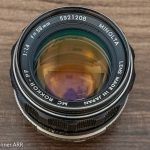
Almost all of the original Minolta lenses were identified as Auto Rokkor while the MC lenses carry the legend Rokkor-X. The early MD lenses also carried the Rokkor-X designation, but the name disappeared along the way. Even Minolta’s economy Celtic line carried the MC marking.

The new Maxxum A-mount spelled the end of backwards compatibility. The X-mount lens opening was too small to allow for the various sensors and contacts required for the electronic focusing components. So the A-mount was born, with a larger opening and electronic connections to replace many of the X-mount’s mechanical workings. The two mounts look similar, but the lenses are not interchangeable between the systems.

Contrary to popular belief, however, the introduction of the A-mount did not spell the end of the X-mount. Minolta continued to produce variations of the X700 and X-570 cameras for many years after the introduction if the Maxxum and the A-mount. I was quite shocked to see that Minolta still offered the X700 in it’s product line in 2000, some fifteen years after the introduction of the A-mount.

That means you cannot use a timeline to identify whether a lens will fit the A-mount dSLRs. A Minolta lens purchased in, say 1996, is probably a A-mount, but could very possibly be an X-mount.

In addition, that also means that there is a huge amount of older SR, MC and MD glass out there, some of it fairly new. No wonder there is so much interest in using these great old lenses on modern dSLRs.

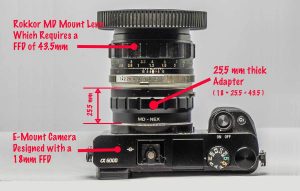
There are options to use the Rokkor lenses on the A-mount and other cameras — with some severe restrictions. We’ll discuss that in part three. Before we get into that, however, we need to explore Minolta’s (and Sony’s) A-mount lenses.

While I used my own experience and my collection of old Minolta literature to assemble this article, I did use some other Minolta-related websites to check some facts and dates. If you want to delve deeper into Minolta manual lenses, try Minman at http://members.aol.com/manualminolta/. You’ll find a wealth of information about manual-focus Minolta cameras and lenses. Another excellent source is Peter Blaise Monahon’s website at http://www.geocities.com/peterblaise/minoltamf/. Either of these sites should provide you with all the info you want on the SR, MD and MC lenses.

Next time we will look at the A-mount and which Minolta lenses fit the Alpha dSLRs.


Who is that guy?


Web designer and photographer Tom Bonner has three decades of experience with Minolta camera equipment

Hi. I'm Tom Bonner and I've been shooting with Minolta SLRs for over three decades.

Alphatracks is my attempt to follow Sony's maneuvers in the dSLR market, and at the same time provide a resource for Minolta film and digital SLR users. A-mount shooters have to watch each other's backs, because there aren't as many of us. At least not for now....

You can view my design portfolio at http://adventuresindesign.com.


Bad Behavior has blocked 877 access attempts in the last 7 days.

Close
E-mail It